














Political Storm Erupts Over Karnataka Officer's Suspension for RSS Event Participation
Bengaluru — A decision by Karnataka's Congress-led government to suspend a Panchayat Development Officer for attending a Rashtriya Swayamsevak Sangh (RSS) event has ignited a fierce political confrontation between the ruling party and the Bharatiya Janata Party, raising questions about civil service neutrality and freedom of association.
The Suspension That Sparked Controversy
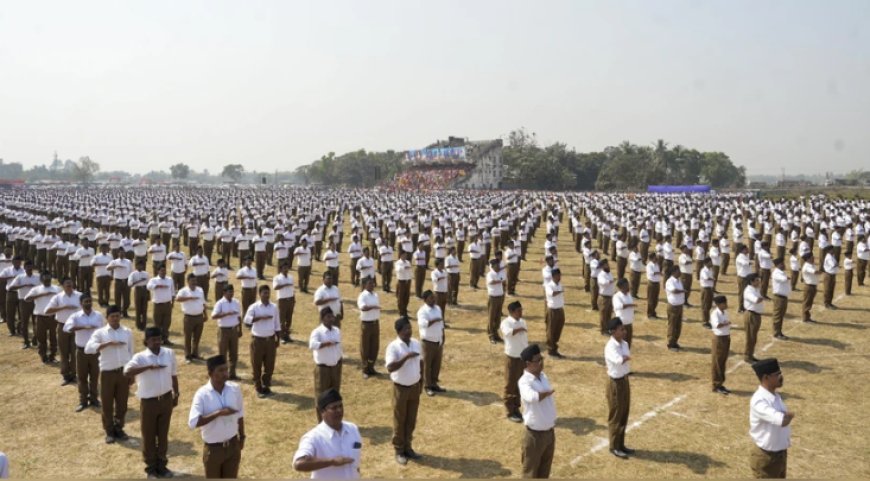
Praveen Kumar, a Panchayat Development Officer in Karnataka's Rural Development and Panchayat Raj Department, found himself at the center of a political maelstrom after his suspension for participating in an RSS parade while wearing the organization's uniform. The action was taken under the Karnataka Civil Services Rules, which mandate that government employees maintain political neutrality and avoid activities that could compromise their official responsibilities.
The suspension represents more than an isolated disciplinary measure. It signals a broader policy shift by the state government regarding the intersection of public service and organizational affiliations.
A Systematic Approach to Enforcement
Minister Priyank Kharge, who heads the Rural Development and Panchayat Raj Department, has initiated a systematic campaign to address what the government views as violations of civil service conduct rules. His department has begun issuing show-cause notices to multiple government officers who attended RSS centenary celebrations, with suspensions planned for those found in violation.
The government's position rests on the Karnataka Civil Services Conduct Rules, which explicitly prohibit government servants from membership or association with political parties or organizations engaged in political activities. State officials argue that maintaining this boundary is essential for ensuring impartial governance and public trust in administrative institutions.
Expanding Beyond Individual Cases
The Karnataka government has extended its reach beyond individual suspensions. In a significant policy decision, the administration has moved to prohibit activities of private organizations in government and government-aided schools, colleges, and public spaces. This measure specifically targets the RSS practice of conducting Shakhas—daily assemblies and training sessions—in government institutions.
Proponents of this policy argue that government facilities should remain neutral spaces, free from the influence of any particular ideological organization. They contend that allowing such activities blurs the line between public institutions and private organizational interests.
The Opposition Strikes Back
The BJP has responded with fierce criticism, viewing these actions as politically motivated attacks on their ideological affiliates. State BJP president BY Vijayendra characterized the suspension as evidence of what he termed the Congress party's biased and anti-Hindu mindset. He has demanded the immediate revocation of Praveen Kumar's suspension and accused the state government of discrimination.
BJP leaders have framed the issue not merely as an administrative matter but as a question of fundamental rights. They argue that participation in cultural and social organizations during personal time should not subject government employees to disciplinary action, particularly when such participation doesn't interfere with official duties.
The party has vowed to continue supporting RSS programs despite government restrictions, setting the stage for potential further confrontations.
The Larger Constitutional Question
At the heart of this controversy lies a fundamental tension in democratic governance: where does legitimate regulation of civil service conduct end and infringement on personal freedoms begin? Government employees, like all citizens, possess constitutional rights to freedom of association and expression. However, these rights exist alongside responsibilities to maintain the neutrality and impartiality expected of public servants.
The RSS, founded in 1925, describes itself as a cultural and social organization dedicated to promoting Hindu values and national unity. However, its relationship with politics—particularly through its historical and ideological connections with the BJP—complicates its status under civil service conduct rules.
Critics of the Karnataka government's actions argue that the RSS is primarily a cultural organization and that attending its events should not automatically be considered a political act. They point out that millions of Indians participate in RSS activities without holding any political office or aspirations.
Supporters of the government's stance counter that the RSS's undeniable influence on political discourse and its organizational ties to a major political party make it impossible to separate participation in its events from political association.
Implications for Civil Service
This controversy has significant implications for civil servants across Karnataka and potentially other states. Government employees now face uncertainty about which organizational affiliations might be deemed incompatible with their positions. The lack of clear precedent or detailed guidelines creates a grey area that could affect thousands of civil servants who participate in various social, cultural, or religious organizations.
The situation also raises questions about consistency in enforcement. Will the government apply similar scrutiny to employees associated with other organizations that have political connections? How will authorities distinguish between genuinely cultural activities and those with political implications?
National Reverberations
While this controversy has erupted in Karnataka, its implications extend far beyond state boundaries. As state governments across India navigate the complexities of maintaining civil service neutrality while respecting individual freedoms, the Karnataka case may set important precedents.
The matter also arrives at a moment of heightened political polarization in India, where disputes over cultural and religious organizations frequently take on outsized political significance. Both major parties have seized upon this issue to energize their respective bases and articulate competing visions of secularism and civil service neutrality.
The Path Forward
As this controversy unfolds, several questions remain unanswered. Will the suspended officer challenge his suspension through legal channels? Will other states adopt similar policies regarding organizational participation by government employees? And perhaps most importantly, can a resolution be found that balances the legitimate needs of civil service neutrality with the fundamental rights of government employees?
What began as a single suspension has evolved into a flashpoint for larger debates about the role of ideology in public life, the boundaries of civil service conduct, and the nature of political neutrality in a diverse democracy. As Karnataka's political parties continue their confrontation, the ultimate resolution of this matter may shape civil service policy and political discourse for years to come.
What's Your Reaction?
 Like
0
Like
0
 Dislike
0
Dislike
0
 Love
0
Love
0
 Funny
0
Funny
0
 Angry
0
Angry
0
 Sad
0
Sad
0
 Wow
0
Wow
0